
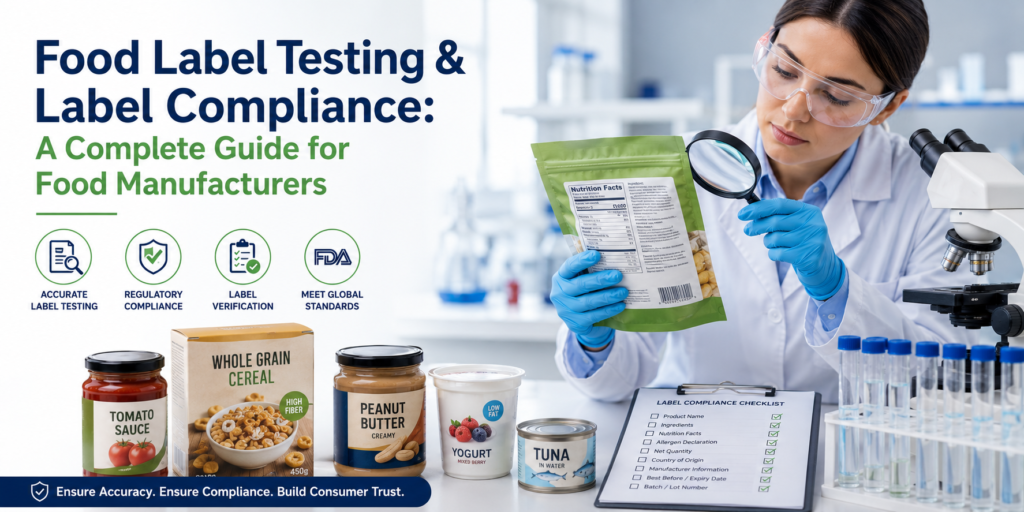
Food Label Testing & Label Compliance: Ensuring Accuracy, Safety and Consumer Trust
Food labels are much more than product packaging – they are a legal requirement and a critical source of information for consumers. Every declaration on a food label, from nutritional values and ingredients to allergen information and expiry dates, must be accurate and supported by reliable laboratory analysis.
Incorrect or misleading labels can result in regulatory action, product recalls, loss of consumer trust and financial penalties. This is why food label testing has become an essential part of food quality assurance and regulatory compliance.
Whether you manufacture packaged foods, beverages, dairy products, bakery items, snacks, spices, confectionery or ready-to-eat meals, proper food label testing helps ensure that your products meet regulatory requirements and consumer expectations.
What is Food Label Testing?
Food label testing is the laboratory verification of the information printed on food packaging. It confirms that nutritional values, ingredient declarations, allergen statements and other label claims accurately reflect the product.
Testing supports compliance while helping manufacturers provide transparent and reliable product information.
Why is Food Label Testing Important?
Accurate labelling protects both consumers and food businesses.
Proper food label testing helps:
- Verify nutritional information
- Confirm ingredient declarations
- Support allergen labelling
- Meet regulatory requirements
- Reduce the risk of product recalls
- Build consumer confidence
- Support export documentation
- Protect brand reputation
What Does Food Label Testing Include?
Laboratory testing can verify several important label parameters, including:
1. Nutritional Analysis
Testing verifies:
- Energy (Calories)
- Protein
- Carbohydrates
- Total Sugar
- Added Sugar
- Total Fat
- Saturated Fat
- Trans Fat
- Dietary Fibre
- Sodium
These values are used to prepare accurate nutrition information panels.
2. Ingredient Verification
Ingredient testing confirms that the product composition matches the declared ingredients on the label.
It helps identify:
- Ingredient authenticity
- Product consistency
- Adulteration
- Ingredient substitution
3. Allergen Verification
Food allergens can cause severe health risks for sensitive consumers.
Testing can help verify the presence of common allergens such as:
- Milk
- Peanut
- Soy
- Wheat
- Tree Nuts
- Egg
- Fish
- Shellfish
Proper allergen labelling improves consumer safety.
4. Additive Verification
Laboratories may verify permitted food additives, including:
- Preservatives
- Artificial Colours
- Sweeteners
- Flavour Enhancers
- Acidity Regulators
Testing ensures declared additives comply with applicable regulations.
5. Claim Verification
Manufacturers often make marketing claims such as:
- High Protein
- Low Fat
- Sugar Free
- Gluten Free
- High Fibre
- Rich in Calcium
Food label testing helps validate these claims with laboratory evidence.
Which Food Products Require Label Testing?
Almost every packaged food product benefits from food label testing, including:
- Dairy Products
- Bakery Products
- Snacks
- Beverages
- Ready-to-Eat Foods
- Frozen Foods
- Spices
- Edible Oils
- Dry Fruits
- Nutraceutical Products
- Health Foods
- Confectionery
Benefits of Food Label Testing
Regular food label testing offers many business advantages:
- Improves regulatory compliance
- Supports product registration
- Reduces legal risks
- Enhances consumer confidence
- Minimizes product recalls
- Improves export readiness
- Verifies label accuracy
- Strengthens quality assurance
- Protects brand credibility
When Should Food Labels Be Tested?
Manufacturers should perform testing:
- Before launching a new product
- After changing a recipe
- When changing ingredient suppliers
- Before updating packaging artwork
- During routine quality verification
- Before export shipments
Periodic verification helps maintain consistency across production batches.
Choosing the Right Food Testing Laboratory
When selecting a laboratory for food label testing, consider:
- Laboratory accreditation
- Experienced food analysts
- Modern analytical instruments
- Comprehensive nutritional testing
- Fast turnaround time
- Reliable reporting
- Technical guidance
- Regulatory knowledge
Working with an experienced laboratory ensures dependable results and accurate label declarations.
Conclusion
Accurate food labels are essential for consumer safety, regulatory compliance and brand credibility. Food label testing provides scientific verification of nutritional values, ingredients, allergens and label claims, helping manufacturers deliver products that meet legal requirements and customer expectations.
By incorporating routine food label testing into your quality assurance program, you can reduce compliance risks, improve transparency and build long-term consumer trust.