Introduction
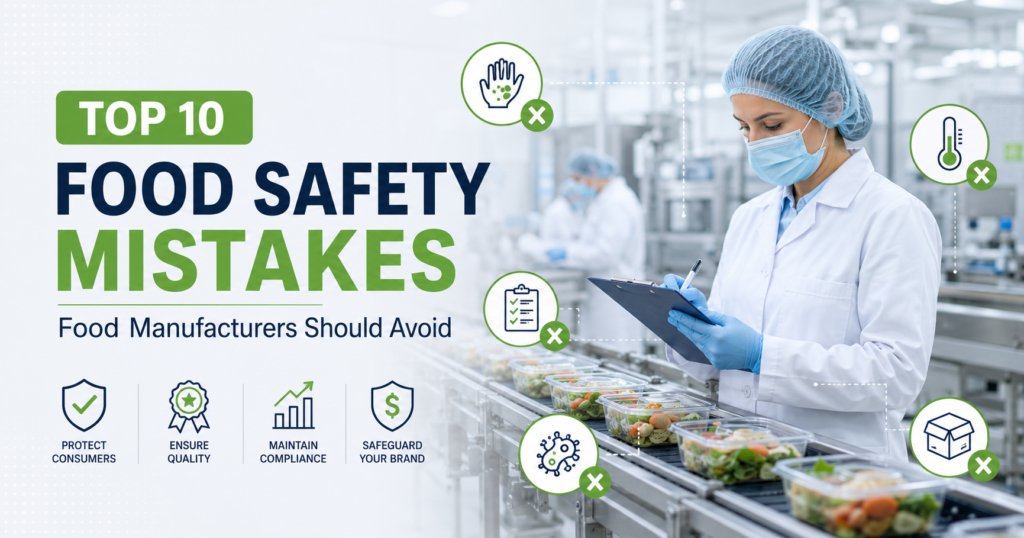
Food safety is not just a regulatory requirement—it is a critical factor that directly impacts product quality, consumer trust and business reputation. Even small mistakes in food manufacturing processes can lead to contamination risks, product recalls, customer complaints and financial losses.
Many food safety issues are preventable when businesses understand common mistakes and implement proper control measures. Whether you operate a large food manufacturing facility or a growing food startup, avoiding these food safety mistakes can help protect your products, customers and brand reputation.
In this guide, we explore the top food safety mistakes food manufacturers should avoid and how proactive quality management can support safer food production.
1. Ignoring Raw Material Quality
Food safety starts with the ingredients used in production. Poor-quality or contaminated raw materials can introduce risks into the manufacturing process before production even begins.
Common Issues
- Unverified suppliers
- Inconsistent ingredient quality
- Poor storage conditions
- Lack of incoming material inspections
Best Practice
Implement supplier evaluation procedures and regularly assess incoming materials for quality and safety.
2. Inadequate Employee Hygiene Practices
Food handlers play a critical role in maintaining food safety standards.
Common Mistakes
- Improper handwashing
- Lack of protective clothing
- Poor personal hygiene
- Inadequate food safety awareness
Best Practice
Provide regular food safety training and establish clear hygiene protocols for all employees.
3. Poor Cleaning and Sanitation Programs
Insufficient cleaning procedures can allow contaminants to accumulate on production equipment and food contact surfaces.
Risks
- Product contamination
- Microbial growth
- Reduced product quality
- Increased operational risks
Best Practice
Develop documented cleaning schedules and regularly verify sanitation effectiveness.
4. Inadequate Temperature Control
Temperature management is one of the most important factors affecting food safety.
Common Problems
- Improper storage temperatures
- Poor monitoring systems
- Delayed cooling processes
- Inconsistent refrigeration practices
Best Practice
Implement temperature monitoring procedures throughout production, storage and distribution.
5. Lack of Regular Food Testing
Many food businesses rely solely on visual inspections, which may not identify underlying quality or safety concerns.
Why This Is a Problem?
Potential issues may remain undetected until products reach customers.
Best Practice
Conduct regular food testing to evaluate product quality, microbiological conditions and overall food safety performance.
6. Cross-Contamination During Production
Cross-contamination can occur when contaminants transfer between ingredients, equipment, employees or production areas.
Common Sources
- Shared equipment
- Poor workflow design
- Inadequate segregation
- Improper handling procedures
Best Practice
Establish clear separation between raw and finished products and implement contamination prevention measures.
7. Poor Documentation and Record Keeping
Many manufacturers underestimate the importance of accurate documentation.
Consequences
- Difficulty identifying issues
- Challenges during audits
- Reduced traceability
- Compliance concerns
Best Practice
Maintain records for production, sanitation, testing, training and quality control activities.
8. Neglecting Environmental Monitoring
The production environment can significantly influence food safety and product quality.
Common Oversights
- Ignoring production area hygiene
- Lack of environmental monitoring
- Inadequate facility maintenance
Best Practice
Regularly assess production environments and monitor sanitation effectiveness.
9. Overlooking Shelf Life Evaluation
A product may appear acceptable during production but experience quality deterioration during storage.
Potential Risks
- Reduced product stability
- Customer complaints
- Product waste
- Brand reputation issues
Best Practice
Conduct shelf life studies to understand product performance under expected storage conditions.
10. Failing to Invest in Food Safety Training
Employees cannot follow procedures they do not understand.
Common Problems
- Inconsistent practices
- Knowledge gaps
- Reduced food safety awareness
- Increased operational risks
Best Practice
Provide regular food safety training programs and reinforce best practices through continuous learning initiatives.
How Food Testing Helps Prevent These Mistakes?
Food testing provides valuable insights into product quality, safety and process performance.
Regular testing can help businesses:
- Identify quality concerns early
- Monitor microbiological conditions
- Evaluate product consistency
- Support shelf life studies
- Improve operational decision-making
- Strengthen food safety programs
Food testing should be viewed as a preventive tool rather than a corrective measure.
Benefits of a Proactive Food Safety Approach
Businesses that actively manage food safety often experience:
Better Product Quality
Consistent quality improves customer satisfaction and brand credibility.
Reduced Business Risk
Early identification of concerns supports more effective risk management.
Improved Operational Efficiency
Well-managed food safety systems often lead to smoother production processes.
Greater Customer Confidence
Consumers increasingly prefer brands that demonstrate commitment to food safety and quality.
Conclusion
Food safety mistakes can be costly, but most are preventable with proper planning, training, testing, and quality control practices.
By focusing on raw material quality, employee hygiene, sanitation, temperature control, food testing, shelf life evaluation and continuous improvement, food manufacturers can strengthen their food safety systems and improve long-term business performance.
Food safety is not a one-time activity – it is an ongoing commitment that helps protect customers, products and brand reputation.
Need Food Testing Support?
OXYPRO supports food manufacturers with food testing, microbiological testing, shelf life studies, hygiene assessments, food safety training and quality improvement initiatives. Contact our team to discuss your food safety and testing requirements.