Introduction
Water is used everywhere -drinking, food production, hospitality, manufacturing and cleaning processes. But here’s the uncomfortable truth: most water looks clean but isn’t actually safe.
Water testing is the only reliable way to confirm whether water is fit for consumption or industrial use. For any business handling food, beverages or even sanitation processes, water quality directly impacts safety, compliance and reputation.
What Is Water Testing?
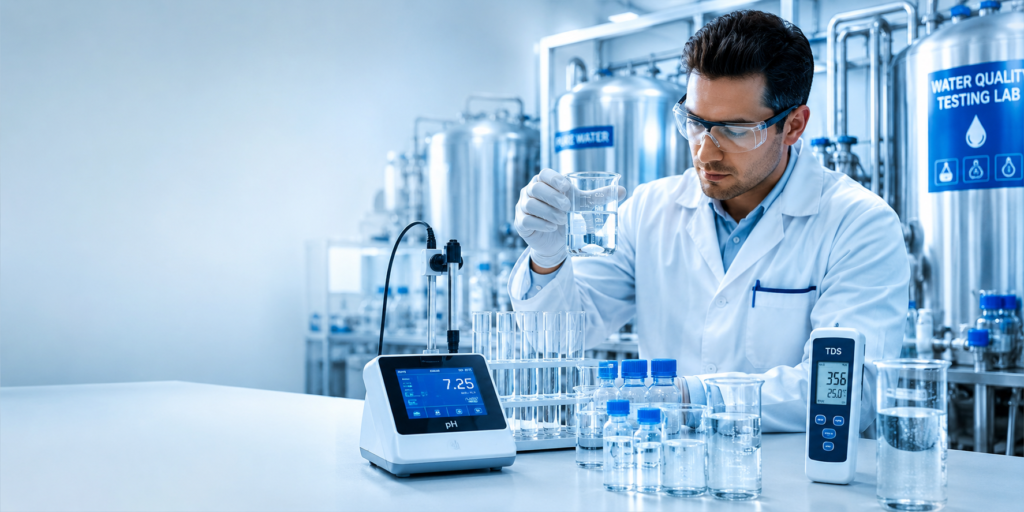
Water testing is the scientific analysis of water to check its physical, chemical and biological quality.
It identifies whether water is safe or contaminated by evaluating:
- Microorganisms (bacteria, viruses, pathogens)
- Chemical pollutants (heavy metals, chlorine, nitrates)
- Physical properties (color, odor, turbidity)
- Dissolved solids and impurities (TDS, hardness, minerals)
Water testing is done at multiple points:
- Source water (borewell, municipal supply, tankers)
- Storage systems (tanks, pipelines)
- Process water (used in production)
- Final usage point (drinking or packaging stage)
Why Is Water Testing Important?
1. Ensures Safe Drinking and Usage
Contaminated water is one of the fastest ways to spread disease in homes and businesses.
Testing helps detect:
- E. coli and coliform bacteria
- Chemical contamination
- Heavy metals like lead and arsenic
- Excess salts and hardness
If you skip this, you’re assuming safety – not ensuring it.
2. Prevents Food and Beverage Contamination
In food and beverage businesses, water is not just an ingredient – it’s a base input.
Bad water = bad product.
Water testing ensures:
- No taste or odor distortion
- No microbial contamination in food prep
- No chemical reaction affecting product quality
- Safe processing conditions in manufacturing
3. Protects Customer Health and Brand Reputation
One contamination incident can destroy years of brand building.
Water testing helps avoid:
- Food poisoning cases
- Customer complaints
- Product recalls
- Legal action and penalties
Reality check: trust is easier to lose than rebuild.
4. Supports Regulatory Compliance
Most industries must comply with water quality standards (municipal, FSSAI-linked processes, industrial norms, etc.).
Testing helps businesses:
- Pass inspections and audits
- Maintain documentation for compliance
- Avoid fines or shutdown risks
- Meet ISO and quality certifications
5. Improves Operational Efficiency
Poor water quality silently damages equipment and increases costs.
Testing helps reduce:
- Scaling in pipelines and machinery
- Corrosion in equipment
- Frequent maintenance cycles
- Production inconsistencies
Types of Water Testing
Microbiological Testing
Checks for harmful microorganisms.
Includes:
- Total coliform count
- E. coli detection
- Bacterial contamination levels
Chemical Testing
Evaluates chemical safety of water.
Includes:
- pH levels
- Chlorine content
- Nitrate and fluoride levels
- Heavy metals (lead, mercury, arsenic)
Physical Testing
Analyzes visible and sensory parameters.
Includes:
- Color
- Odor
- Turbidity
- Temperature
TDS and Hardness Testing
Measures dissolved minerals in water.
Helps identify:
- Water suitability for consumption
- Scaling risk in machines
- Taste and quality impact
Industrial Water Testing
Used for manufacturing and processing units.
Checks:
- Boiler feed water quality
- Cooling system water
- Process-specific purity levels
Who Needs Water Testing?
Food & Beverage Businesses
Restaurants, cloud kitchens, packaged food brands – water quality directly impacts product safety.
Hotels and Hospitality
Guest health and hygiene depend on water quality.
Manufacturing Units
Water affects machinery, processes and output quality.
Hospitals and Clinics
Critical for hygiene, sterilization and patient safety.
Residential Societies
Ensures safe drinking water supply for residents.
Bottled Water Plants
Mandatory for compliance and brand trust.
Common Water Quality Problems
Most businesses unknowingly face:
- Contaminated borewell water
- Poor filtration systems
- Tank contamination
- Pipeline bacterial growth
- Excess hardness and scaling
- Chemical imbalance
These issues don’t show immediately – but damage builds over time.
Benefits of Regular Water Testing
Higher Safety Standards
Early detection prevents contamination risks.
Better Product Quality
Especially critical for food and beverage industries.
Lower Maintenance Costs
Protects equipment and reduces breakdowns.
Stronger Compliance Position
Easier audits and certifications.
Brand Trust
Safe water = safe business perception.
When Should Water Be Tested?
Water testing should not be “once in a while.”
It should happen:
- Before starting any food or beverage operation
- After installation of filtration systems
- Periodically (monthly / quarterly depending on usage)
- After contamination suspicion
- During audits and certifications
- After infrastructure changes
Conclusion
Water testing is not a technical formality – it is a risk control system for your business.
If your water is unsafe, everything built on it becomes unstable – products, customers and reputation.
For any serious business in food, hospitality or manufacturing, water testing is not optional – it’s foundational.
Need Water Testing Support?
If you want accurate water quality analysis, contamination checks or compliance support, OXYPRO helps businesses identify risks and maintain safe water standards across operations.